Meditation Is Boring
Pointers to the Oasis

People often say that meditation is boring. In a sense, they are right—but only because they mistake one stage of practice for the whole journey.
When people try meditation for the first time, or only occasionally, they often enjoy it. They leave feeling calmer, more relaxed, perhaps a little refreshed. This is good meditation, but it is only the beginning. It is primarily relaxational meditation. There is real value in it, but it is also relatively easy.
The challenge comes when meditation becomes a regular practice. Sitting every day or every week for twenty minutes or more requires discipline. You are learning a skill. You are training attention. The novelty wears off. Progress seems slow. The practice becomes routine, and many people conclude that meditation is boring.
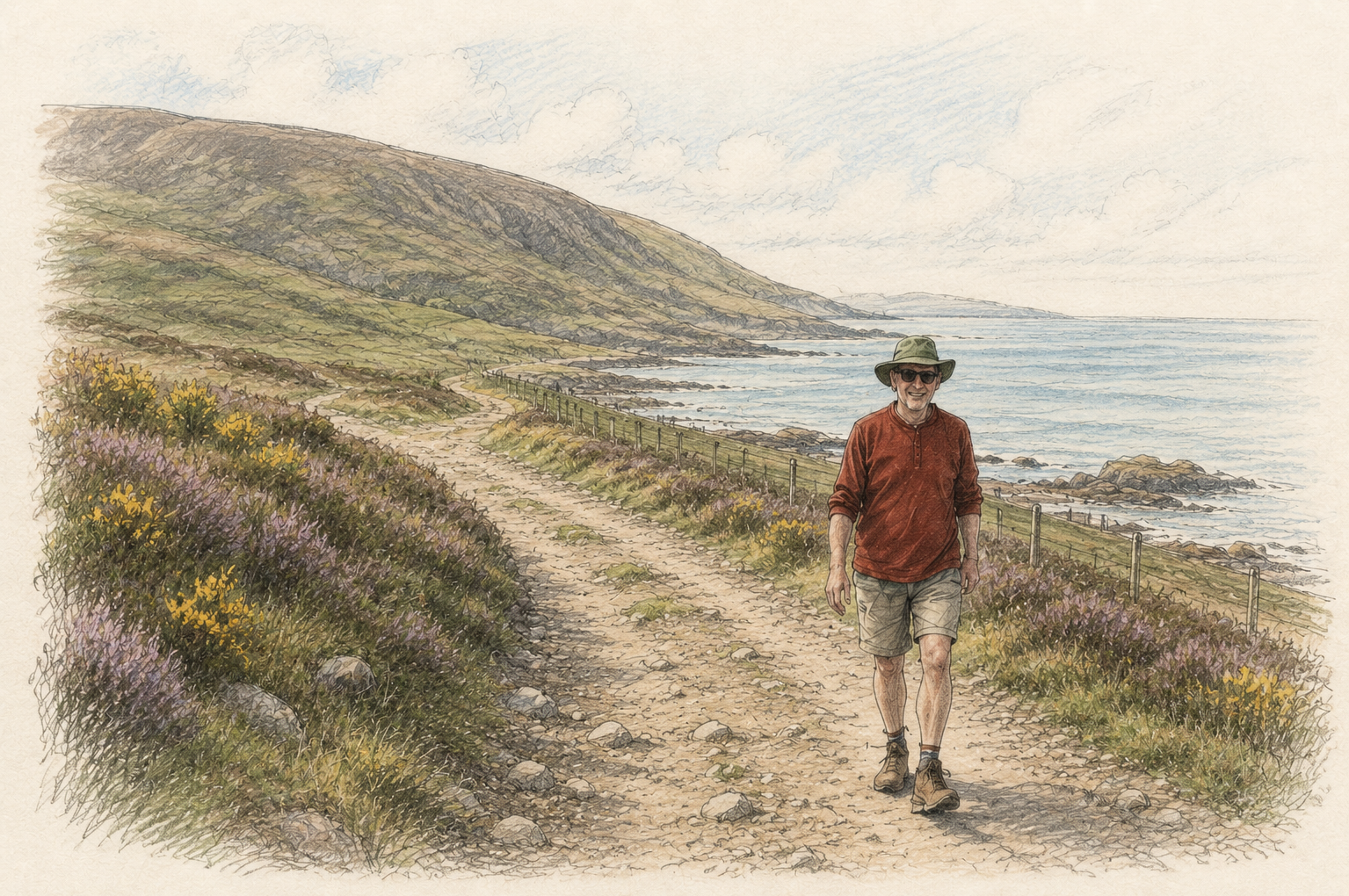
For many meditators, this is the desert. Some turn back. Others keep walking.
But meditation asks a question in return. What do you mean by boring?
Is boredom always something to avoid? Must every moment be stimulating? Our modern world trains us to expect constant novelty, yet our minds are not necessarily healthier for it. There is value in occasionally doing one simple thing, repeatedly and without hurry. If not meditation, then gardening. Is it really so difficult to spend twenty minutes pulling weeds? Many people discover that weeding the garden becomes, quite naturally, meditative. Repetitive, single-minded activity gives the restless mind an opportunity to settle.
There is another way through boredom: curiosity.
You can gamify meditation, and there is nothing wrong with that. Treat each meditation as an exploration. How long can you follow the sensations of the inhale before they disappear? How long can you remain with the exhale? What subtle variations in temperature, pressure, sound, or movement can you detect? Does the breath have a taste at all? Every sitting becomes an opportunity to notice something you have never noticed before.
The breath is not nearly as simple as it first appears. A curious mind discovers that ordinary experience contains extraordinary detail. What once seemed monotonous becomes endlessly interesting.
With continued practice, something else begins to emerge. You experience the quiet joy of competence.
At first, this joy comes simply from discovering that you can direct your attention more steadily than before. You notice it during meditation. Then you notice it outside meditation as well. Conversations become easier to follow. Reading becomes deeper. You catch distractions sooner. Your attention becomes something you can trust. The practice is paying off, and it feels good. There is nothing wrong with enjoying this reward. It encourages you to continue.
As the hours accumulate—tens of hours, then hundreds—meditation begins to change. The effortful stage gradually gives way to something softer. What was once a dry exercise in concentration becomes infused with quiet joy. Your habits of attention gradually change. Instead of repeatedly reinforcing distraction, muddledness, craving, and suffering, you spend increasing amounts of time cultivating mindfulness, presence, and contentment.
The practice is no longer sustained by discipline alone. Attention itself becomes rewarding. The breath that once seemed ordinary reveals endless subtlety. Stillness no longer feels empty but alive. You find yourself looking forward to sitting down, not because you should, but because you want to.
You realize that what you once called boredom was simply unfamiliarity. You had not yet stayed with the practice long enough to discover what lay beyond it.
The ancient meditation traditions describe increasingly joyful states of practice, but you do not need to know their names to experience them. They are not reached through belief or mysticism, but through patience, curiosity, and sustained practice.
You thought you were crossing a desert. Instead, you had reached an oasis.
1937 Mapping the Human Cortex
A Neurotech History Series
Imagine remaining awake while a surgeon gently stimulates different parts of your brain with a tiny electrode.
During epilepsy surgery, Canadian neurosurgeon Wilder Penfield asked awake patients to describe what they experienced as he stimulated the cerebral cortex. Different locations produced different sensations, movements, and occasionally vivid memories, allowing him to map the functional organization of the human brain.
Penfield’s work transformed neurosurgery and deepened our understanding of the cortex. Functional brain mapping remains fundamental to neurosurgery, neurostimulation, and modern neurotechnology.
Meditation Community – Fall Equinox Series
A Standardized Method for Counting Distractions

The online Meditation Community, facilitated by John Miedema of Alcove Quebec, will begin a new eight-week series during the week of the Fall Equinox. There is no cost.
Meditation sessions will be held once each week on a weekday evening. A community poll will determine the final day and time.
This series will focus on cultivating sustained attention to the breath. Participants will also have the option of using A Standardized Method for Counting Distractions in Meditation (link). This practical method provides a measurable way to observe improvement in concentration over time while reinforcing the benefits of greater attention, mindfulness, and well-being.
This autumn I would also like to formally welcome people living with Parkinson’s disease. As someone with Parkinson’s myself, I understand that meditation can seem intimidating. Parkinson’s is often associated with tremor, while meditation is commonly associated with physical stillness. In practice, however, physical stillness is not the goal. The deeper practice is the cultivation of inner stillness and stable attention, regardless of what the body is doing.
To receive updates, participate in the scheduling poll, please subscribe to the Meditation Community newsletter: https://meditationcommunity.substack.com/. You can also visit my website: https://johnmiedema.art/.
Human Slop and AI Art
AI art begins with something only a human can offer: a sketch, a memory, a photograph, a fleeting feeling, a rough idea. These are the humble beginnings of creation—what we might affectionately call human slop. Not an insult, but an acknowledgment that every work of art begins imperfectly.
Then begins a collaboration. Art has always been an interaction between an artist and objects: paint and canvas, chisel and stone, camera and light. AI is the newest medium. The artist prompts, nudges, whispers. AI answers with possibilities. The artist listens, chooses, and refines. Together they work until the art emerges.
1924 Recording the Brain’s Electrical Activity
A Neurotech History Series
Until the 1920s, no one had successfully recorded the brain’s electrical activity from outside the skull.
German psychiatrist Hans Berger developed the electroencephalogram (EEG), demonstrating that tiny electrical signals from the brain could be measured non-invasively from the scalp.
EEG opened a completely new window into brain function and quickly became an essential clinical and research tool.
Modern hospital EEG systems and consumer brain-sensing devices trace their origins to Berger’s pioneering work.
1897 The Synapse Is Born
A Neurotech History Series
Scientists knew neurons communicated, but how one cell influenced another remained unclear.
Charles Sherrington introduced the term ‘synapse’ to describe the tiny junction where one neuron communicates with the next. His work explained how billions of individual cells form coordinated networks.
The concept of the synapse became central to understanding learning, memory, and neurological disease.
Today’s neuroscience and many neurotechnologies are built on understanding and influencing synaptic communication.
AI Data Centres vs the Climate Crisis
Both matter. They are not equally urgent.

There is growing concern about the environmental impact of AI data centres. It is an important concern, and one we should address. But it should not distract us from a far more urgent environmental challenge: the climate crisis.
The environmental impact of AI data centres is primarily an engineering problem. These facilities consume large amounts of electricity, generate significant heat, and in many cases require substantial quantities of water for cooling. Where freshwater is scarce, this can place additional pressure on local communities and ecosystems. New data centres should be powered by low-carbon electricity, designed for maximum efficiency, make greater use of reclaimed or non-potable water, and be located where they do not compete with local populations for limited freshwater resources. These are real environmental concerns, but they have identifiable engineering and planning solutions. There is every reason to believe AI infrastructure will become dramatically more efficient over time.
The climate crisis is different. It is not simply an engineering problem; it is a planetary systems problem. Its consequences are already escalating year after year: record-breaking heat waves, more destructive wildfires, longer droughts, heavier rainfall, stronger storms, rising sea levels, biodiversity loss, and growing pressures on food production, water supplies, and human health. Much of the damage already caused cannot be reversed on human timescales. Species lost to extinction will not return. Ice sheets and sea levels respond over centuries. Carbon dioxide remains in the atmosphere for generations. We cannot simply engineer our way back to the world we once had.
AI should be built responsibly, but its potential should also be recognized. It can advance science, improve healthcare, enrich culture, increase productivity, and help solve some of humanity’s most difficult problems—including the climate crisis itself through better energy systems, materials, forecasting, and optimization. The climate crisis, by contrast, is an extraordinarily difficult global challenge requiring coordinated action across energy, transportation, industry, agriculture, finance, and politics. It will take decades to address, and many of its consequences are already irreversible. In terms of environmental urgency, these are not comparable. If the environmental footprint of AI data centres is a 1, the climate crisis is closer to a 100. Both deserve attention. The climate crisis remains the defining environmental priority of our time.
1888 The Neuron Comes Into Focus
A Neurotech History Series
By the late nineteenth century, many scientists believed the brain formed one continuous network.
Using Golgi’s staining technique, Santiago Ramón y Cajal carefully examined nervous tissue and concluded that the brain is built from individual neurons separated by tiny gaps. He proposed the neuron doctrine, one of the foundational principles of neuroscience.
His work transformed our understanding of how information flows through the nervous system.
Every modern model of neural circuits and brain function builds on Cajal’s insight.
1873 Seeing Neurons for the First Time
A Neurotech History Series
Looking through a microscope, the brain once appeared as an indistinct mass of tangled tissue. Scientists could see cells, but not how individual neurons were organized or connected.
In 1873, Italian physician and scientist Camillo Golgi transformed neuroscience by developing the Black Reaction (la reazione nera), a silver chromate staining technique that randomly stained only a small number of neurons. Because just a few cells were coloured while their neighbours remained transparent, each stained neuron could be seen in its entirety—its cell body, branching dendrites, and long axon. For the first time, researchers could appreciate the extraordinary complexity and diversity of individual neurons.
One laboratory technique opened an entirely new window into the brain’s architecture, laying the foundation for modern neuroscience.
Golgi’s method also enabled Santiago Ramón y Cajal to demonstrate that the brain is composed of individual neurons rather than a continuous network, establishing the neuron doctrine that underpins modern neuroscience.