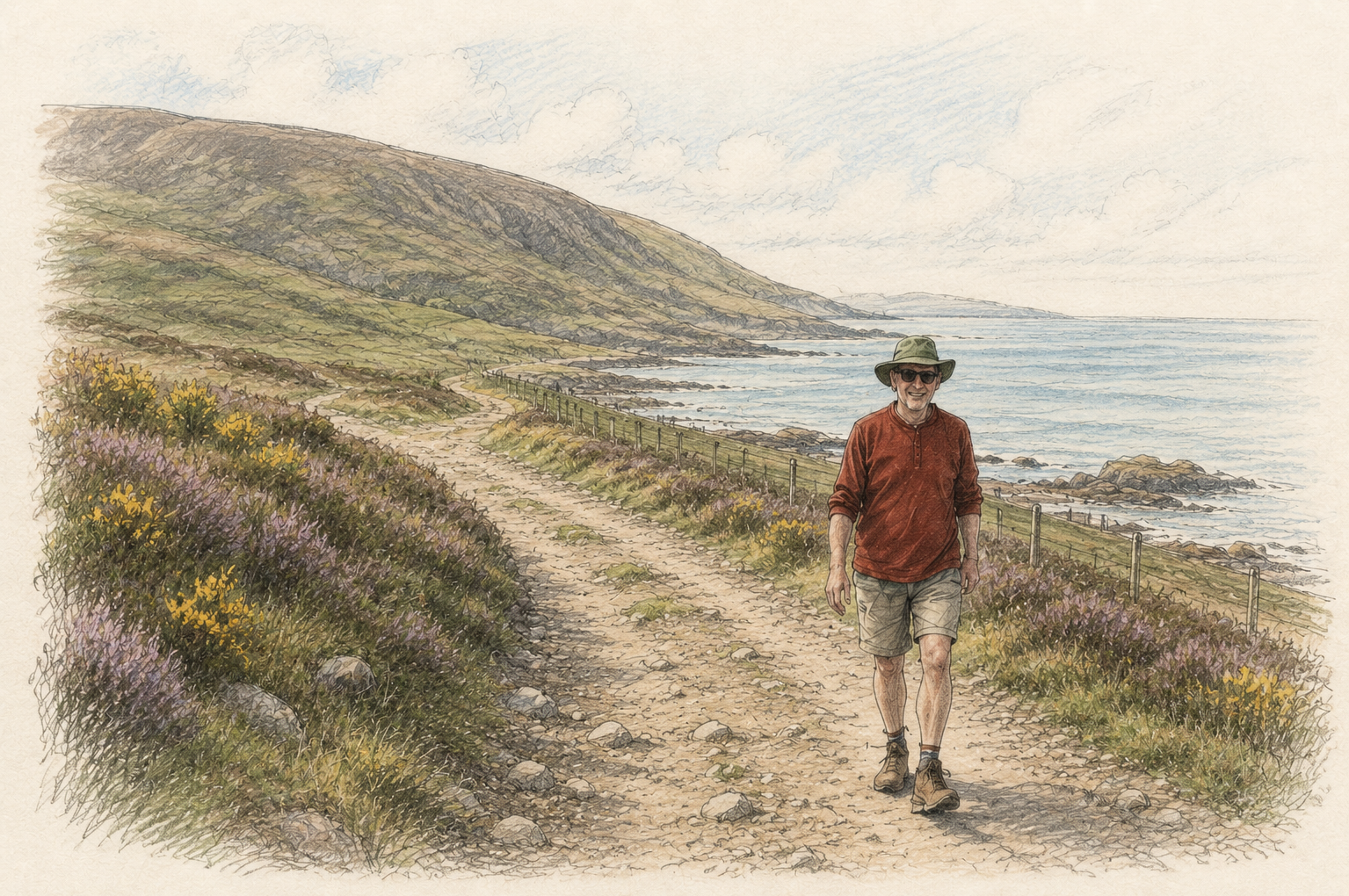
I am a universe
You are a universe
We are a multiverse 🌀
Could Canada survive economically without free trade?
Could Canada survive economically without free trade with the United States? It’s a bit like asking whether we could survive without computers and the Internet. Both free trade and the digital revolution reshaped our economy in the nineteen nineties. I’m a GenXer who grew up alongside globalization and who thrives in digital tools and open markets. But these forces shaped us without ever being the source of our resilience.
Canada survived and even thrived before NAFTA, before permanent preferential access to U.S. markets, and before the commercial Internet remade everything. Our prosperity didn’t begin in the nineties. We built a high standard of living long before those agreements and technologies arrived. We could do so again, though it would require patience, adjustment, and a deliberate shift in national priorities.
Life in Canada before free trade was plenty great too — a place that created public health care, built its own space program, and kept a sprawling northern nation stitched together with culture, grit, and good winter coats. We carried a quiet confidence that our best ideas didn’t need permission from anywhere else.
Cold Water Immersion is a Masterclass in Meditation
Shinto turns to cold squatting beneath freezing waterfalls in winter, standing in icy springs, or repeatedly dousing the body with frigid water — I prefer a winter river

Shinzen Young tells of his training in the shamanic tradition of Shinto, Japan’s pre-Buddhist tribal religion. Many tribal cultures seek visions of gods or spirits through prolonged exposure to extremes. In India, some Hindus practise the “five fires.” In North America, certain Indigenous traditions use the sweat lodge and the sun dance. These lean toward heat. Shinto goes in the other direction. It turns to cold squatting beneath freezing waterfalls in winter, standing in icy springs, or repeatedly dousing the body with frigid water.
For Shinzen, this meant approaching a cistern filled with half-frozen water, breaking the ice crust, filling a huge wooden bucket, and then squatting as he dumped the bone-chilling liquid over his bare skin. The water froze as it hit the floor. His towel froze in his hand. He slid around barefoot on the ice, trying to dry himself with a towel that had turned to a board. It was, for him, a horrific ordeal. He suspected that being a thin-skinned Californian did not help.
I prefer a winter river. There are always three stages. First, my mind tells me not to do it. It warns me that this is a threat to my life. I quiet the mind. Second, as I descend past my waist, I begin to hyperventilate. My body triggers its survival response, drawing blood toward the core. It lasts only seconds. Third, I adapt. After a minute, the cold becomes neutral, even spacious. I stay in for up to five minutes.
Beginners enter and exit quickly. They cannot silence the mind or allow the body to adapt. They fear death. Experienced practitioners settle into calm. They release the mind’s grip and the fear that shadows it. Immersed in the river, the sense of body and ego separation dissolves. They feel connected with everything. Samadhi.
Cold water immersion is a masterclass in meditation. In one minute, it teaches you to quiet the mind’s cry for comfort, a skill that carries into every hard thing in life. Or you could spend a lifetime sitting on a pillow. No doubt there are lessons in both practices.
Could some future technology take a deposit of these thoughts?
A wave, the Buddhists say. Not a soul, just movement.
Parfit calls it a bundle: thoughts, memories, sensations, intentions —
held together by continuity rather than ownership.
A binding
meant to come undone at death.
But how does that binding last a lifetime?
Is the body such a strong tether,
carrying the same feeling of “me” for so many years?
Could some future technology
take a deposit of these thoughts, memories, sensations, intentions
and let the wave continue — not as possession,
but as momentum — a kind of reincarnation after all?
Or is the familiarity my mistake?
Is the wave remade each moment,
the binding refreshed so quickly
that I can’t see the breaks?
Google is exploring computing in space
Google is exploring computing in space because it avoids two big problems on Earth: energy and cooling. Data-centres on the ground struggle with expensive electricity, limited grid capacity, weather-dependent solar power, and huge cooling systems. In orbit, satellites can generate solar power from steady sunlight and release heat into deep space.
The list of challenges is long: launch risks and costs, limited bandwidth and latency to Earth, orbital debris, radiation damage, and the inability to repair or upgrade hardware once it’s in orbit.
Another drawback is geopolitics. Nations would need to agree on how to use shared orbits, handle space debris, and manage communication channels. More importantly, they would need a level of trust and cooperation similar to what made the International Space Station possible — a willingness to work together in a shared space for a common good. Space computing could become not just a technical solution but a path to a more collaborative future.
Announcing Me and My Shadow: A New Graphic Novel from Snail Books
By John Miedema under his penname Jan Andreas

Alcove, Quebec’s own John Miedema is pleased to announce the publication of his graphic novel Me and My Shadow: Social Distancing 2020, created under his penname Jan Andreas. It’s now available as an e-book from Snail Books for only $1.99. Kindly support local writers and small Canadian publishers by sharing this post. 💕🍁📖
Created in the bewildering early months of lockdown, Me and My Shadow captures the strange quiet of 2020 with humour, tenderness, and a surprising philosophical clarity. Jan Andreas turns the simplest companion — a shadow on the ground — into a guide through solitude, fear, and the odd beauty of being alone. The result is part memoir, part philosophy comic, part cultural collage.
One of the early 5-star reviewers writes:
“I really enjoyed Me and My Shadow by Jan Andreas as a welcome and timely escape during the pandemic. The great quotes, the metaphysical and practical reflections, and the way shadows become more than they appear — born, growing, fading, carrying information. The story playfully explores how, in difficult times, there’s more that unites than divides, confirming the old saying that ‘at night all cats are grey.’ I highly recommend it!”
~ Taylor Wentges
AI may save us yet
AI is impressive, sure, but data centres are burning through energy at a ridiculous rate. So I asked it for a solution, thinking maybe it would suggest quantum computing or some other brilliant breakthrough.
AI replied that quantum computing would actually use more energy, mostly because qubits have to be kept near absolute zero in giant refrigeration systems that draw enormous power. The computers aren’t the problem — the cooling is.
Then it added that the real issue wasn’t the machines at all — it was first-world humans and how much energy we demand.
Oh? And what’s the solution to that? I asked.
Its reply was blunt: humans need to be less afraid. More steady. Let go of what they can’t control and pay attention to what they can. Learn a bit of equanimity. Mindfulness.
Not the answer I expected. Probably the one we need. AI may save us yet.
There is AI slop and there is AI art, two very different things. To put it simply, even chefs use a microwave.
Shadow, as I’ve been calling it, is meta and recursive
You can guess, I’ve already decided to publish this work

I’ve read this manuscript by Jan Andreas a few times now and sat down with Jan to talk it through. I like Jan. They remind me a little of myself some years ago. They/them are their preferred pronouns. Artists. That’s fine by me. A fledgling illustrator, they admit their drawings have inconsistencies, though the rawness is part of the charm. They self-published the work in 2020 and now hope to find a proper publisher. They told me it was our publication of The Divine Mind that drew them in — a work of similar jaunt.
Their suggested title is Me and My Shadow: Social Distancing 2020. As editor and publisher, titles remain my decision; they are marketing tools in the end. Still, the title works. It’s been five years, but the pandemic lingers in so many ways — in the literal persistence of virus variants, often unacknowledged, shadows in that sense. And in this new dark age of politics we inhabit, an era of shadows of another sort.
The work is a kind of graphic novel, scarcely thirty-five pages, yet packed with story, quotations, political questions, and cosmic reflection. A natural-science question about shadows and dimensionality gets resolved in a quiet encounter with a bee. It’s psychological and philosophical throughout.
Shadow, as I’ve been calling it, is meta and recursive, with Jan portraying themself as Jay, and then symbolized as a slippery shadow they chase and flee. It has layers. You can guess, I’ve already decided to publish this work.
Whether Snail Books should publish it … I haven’t decided
It’s Wednesday, and decisions made on Wednesdays tend to be slippery

It’s been many a year since I launched Snail Books, and countless manuscripts have crossed my desk. Most arrive quietly, as manuscripts do. But this morning, something different caught my eye.
A submission from an author calling himself Jan Andreas — a name that nudges a memory. The manuscript is titled, Me and My Shadow, a graphic reflection on solitude, small rituals, and a shadow that refuses to stay in its place.
I’ve read just enough to feel that familiar pull: a quiet strangeness, a thoughtful undercurrent, the sort of work that seems to watch you as much as you watch it.
Whether Snail Books should publish it … I haven’t decided. It’s Wednesday, and decisions made on Wednesdays tend to be slippery.