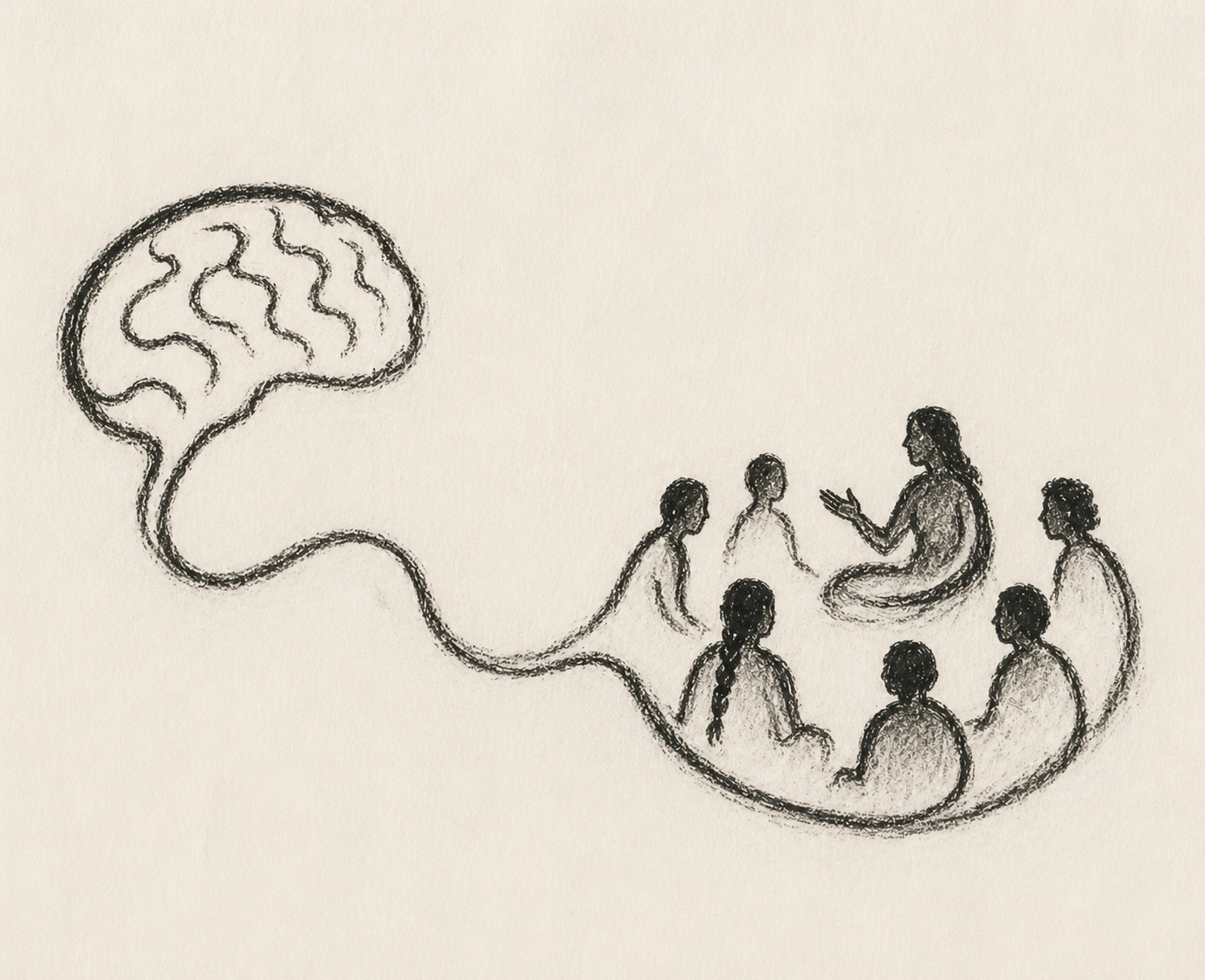
From inward attention and self-regulation to shared meaning, memory, and relationship

It is now widely accepted that Western neuroscience has something meaningful to offer the modern practice of meditation. By identifying neural correlates of attention, awareness, and emotional regulation, it has helped clarify mechanisms that practitioners have long described from within. What remains less clear is how this same lens might extend to other cultural practices, such as Indigenous storytelling. If meditation has been understood as a disciplined training of attention, storytelling may reveal a different but equally structured mode of mind, one that binds attention to memory, identity, and relationship. I am not Indigenous, but I offer these reflections with care, with the view that neuroscience can provide meaningful insight into aspects of this practice, even if it cannot fully account for it.
With meditation, the science has largely focused on the regulation of attention and self. Studies often point to changes in the default mode network, the prefrontal cortex, and the insula. These correlate with reduced rumination, steadier focus, and heightened awareness of the body. The practice is often solitary, deliberate, and method-driven. The brain findings map neatly onto that structure.
With Indigenous storytelling, the experience is less about directing attention inward and more about being drawn into a shared field of meaning. Neuroscience suggests several overlapping processes at work. When we listen deeply to a story, the brain enters a state of narrative absorption. Sensory and associative regions activate as if we are partially living the events. The usual analytic voice softens. This begins to resemble meditative immersion, though reached through story rather than breath.
At the same time, storytelling strongly engages memory systems, especially those linked to identity. The hippocampus helps bind narrative to place, lineage, and personal meaning. Repetition deepens this encoding. What is being trained is not just attention, but belonging.
There is also a social dimension that meditation research is only beginning to touch. In group storytelling, listeners’ brains can synchronize with each other and with the speaker. Rhythm, tone, and pacing entrain attention across the group. Emotion is co-regulated. The experience is not confined to one mind. It is distributed.
Imagery and metaphor add another layer. Stories guide attention through images rather than instructions. The brain’s perceptual systems engage as if encountering the world directly. In this sense, storytelling becomes a way of training perception itself, shaping how reality is noticed and interpreted.
So where meditation trains attention to stabilize and observe, storytelling may train attention to participate, remember, and relate. Neuroscience does not reduce one to the other, but it shows that both are structured ways of shaping mind and experience. One clarifies the mechanics of focus and awareness. The other reveals how identity, community, and world are carried and renewed through attentive listening.
Seen this way, the contribution of neuroscience is not to explain storytelling away, but to quietly confirm that something real and trainable is happening there too.
Last Updated on April 27, 2026 | Published: April 27, 2026