Skip to content
John Miedema
John Miedema

Online Meditation 🧘 Neurotech Research ⚡ Contemplative Writing

  • Home
  • Meditation Community
  • Neurotech Research
  • Essays
    • Books
    • Life
    • Literacy
    • Meditation
    • Neurotech
    • Politics
    • Posthumanism
    • Technology
  • Snail Books
    • News
    • Browse the Store
    • The Divine Mind
    • Me and My Shadow
    • Slow Reading
  • About
John Miedema

Online Meditation 🧘 Neurotech Research ⚡ Contemplative Writing

    Category: Meditation

    A Standardized Method for Counting Distractions in Meditation

    Posted on June 27, 2026June 27, 2026

    A Practical Method for Improving Focus and Mindfulness

    Introduction

    One of the challenges of meditation is knowing whether we are improving. Some sessions feel calm, others seem filled with distraction. Over weeks or months we hope our attention is becoming steadier, but progress is often difficult to perceive because attention is largely invisible.

    Recent years have seen the emergence of neurofeedback devices that estimate attentional states using physiological signals such as EEG. These technologies are fascinating and continue to improve, but they are also relatively expensive and introduce another layer of technology into meditation.

    This essay presents a simpler approach.

    Rather than attempting to measure attention directly, this method records a specific metacognitive event: the moment a meditator recognizes that attention has wandered. That moment of recognition is central to meditation. Before it, the mind is absorbed in thought. After it, attention can be deliberately returned to the meditation object.

    Throughout this essay, counting distractions refers to counting these recognized distractions. The method does not objectively measure attention itself. Rather, it provides an objective, standardized record of metacognitive events. By applying the same counting protocol from one session to the next, the resulting counts become meaningfully comparable across meditation sessions.

    More importantly, this is not merely a method of measurement. It is also a method of training. Each time a distraction is recognized, the meditator performs the very mental act that meditation seeks to cultivate: awareness of distraction followed by a gentle return of attention. The act of measurement becomes an act of practice.

    Relationship to Research

    This method draws upon several well-established findings in cognitive psychology and contemplative science.

    First, researchers have shown that the human mind naturally wanders. Conscious experience rarely remains on one topic for long; attention regularly shifts away from the present task toward internally generated thoughts and feelings. Mind wandering is therefore not a failure of meditation but a normal feature of human cognition (Smallwood & Schooler, 2015).

    Second, an important distinction exists between mind wandering itself and meta-awareness–the moment we realize that the mind has wandered. Schooler and colleagues argue that the mind is only intermittently aware of engaging in mind wandering, and that this recognition represents a distinct metacognitive process (Schooler et al., 2011). This distinction is central to the counting method proposed here.

    Third, mindfulness training has been associated with reductions in mind wandering and improvements in sustained attention. Mrazek, Smallwood, and Schooler (2012) found that mindfulness and mind wandering are opposing constructs in relation to undistracted attention, and that a brief period of mindful breathing reduced behavioral indicators of mind wandering on a later task.

    Fourth, contemplative science has increasingly examined meditation as a training of awareness of spontaneous thought. Brandmeyer and Delorme (2021) propose a neurocognitive framework in which meditation cultivates awareness of mind wandering and supports attention regulation. Their work is especially relevant because it links meditation, spontaneous thought, and metacognitive awareness.

    The method presented here builds on these findings. It does not attempt to detect mind wandering through physiological measurements such as EEG. Instead, it provides a simple, standardized way for meditators to record moments of meta-awareness during meditation itself. Each click records one such event, creating both a measurement of practice and a form of immediate feedback that helps cultivate the very capacity being measured.

    To my knowledge, the literature has focused on detecting mind wandering through experience sampling, behavioral tasks, or physiological measures. The method proposed here offers a simple, standardized practice for recording naturally occurring moments of meta-awareness during meditation itself.

    The Tally Counter

    The method is simple.

    Hold a tally counter comfortably in one hand throughout the meditation. Whenever you recognize that your attention has genuinely wandered from the meditation object, press the counter once. The click records a single metacognitive event: the conscious recognition that attention has drifted. Then gently return your attention to the meditation object.

    The counter is used only when awareness returns after a distraction. Most of the meditation proceeds without interacting with it. At the end of the session, the total provides a standardized record of recognized distractions.

    The tally counter does not objectively measure attention itself. Rather, it provides an objective, standardized record of moments of meta-awareness. It is this distinction that makes the method both simple and scientifically meaningful.

    Why Counting Improves Meditation

    Meditation develops through repeated cycles of attention, distraction, recognition, and return. The moment of recognition is easy to overlook, yet it is the pivot on which the practice turns. Without recognizing distraction, there can be no intentional return to the meditation object.

    The tally counter reinforces this moment. Every click acknowledges, “I noticed.” The click does not record failure. It records awareness.

    Over time, practitioners often notice that distractions are recognized sooner and attention returns more naturally. Early in practice, the distraction count may even increase as awareness becomes more sensitive. This should be welcomed. The goal is not to suppress thoughts but to cultivate the ability to recognize them without judgment.

    Unlike many measurement tools, the tally counter does more than observe the practice. It actively reinforces the skill it measures.

    Choosing a Counter

    I recommend a simple mechanical tally counter.

    Before using any device, I experimented with counting on my fingers. Beginning with both hands closed, I extended one finger after each recognized distraction. Ten fingers are generally sufficient for a twenty- or thirty-minute meditation. This method works, although I occasionally lost track of which fingers had already been extended. A counter simply performs the same task more reliably.

    Digital tally counters are widely available, but I found them less suitable for meditation. The digital counters I tested entered power-saving mode after periods of inactivity. During meditation I could not tell whether the device was awake, and if it had gone to sleep, the first button press merely woke the device instead of recording the distraction. This introduced an unnecessary interruption into the practice.

    A mechanical counter has none of these limitations. It requires no batteries, never sleeps, fits comfortably in the hand, and registers every press immediately with a quiet, reassuring click. After a few sessions, operating it becomes almost automatic.

    The counter should interfere with the meditation as little as possible. Its purpose is not to become another object of attention, but to provide a reliable, consistent record of recognized distractions.

    A Standardized Counting Method

    To make the tally counter a meaningful measurement tool, use it consistently. The objective is not to count every fleeting mental event but to apply the same criteria during every meditation session.

    1. Allow the meditation to settle. Do not begin counting immediately. Give the first minute or so for the mind to settle into the practice.
    2. Count only genuine distractions. Do not count momentary fluctuations of attention. If your attention retains a good hook to the meditation object, it is not a distraction.
    3. Do not count brief instructional self-talk. A simple reminder such as “return to the breath” or “relax the shoulders” is part of the meditation itself, not a distraction.
    4. Count the moment of recognition. When you recognize that attention has genuinely wandered, click the counter once. The click records the metacognitive event–the conscious recognition of distraction. Then gently return attention to the meditation object.

    When in doubt, do not click. Consistency is more important than attempting to count every possible distraction.

    Keeping a Meditation Log

    A single meditation session reveals little. A meditation log reveals patterns.

    After each session, record:

    DateTimeMinutesInternalExternalDistractionsNote
    2026-06-277:00 am302112Poor sleep; noise outside.
    • Date – The date of the meditation session.
    • Time – The time of day the meditation began.
    • Minutes – The length of the meditation session.
    • Internal – Your internal level of distraction before beginning, rated from 1 (low) to 3 (high).
    • External – The level of external distraction in the meditation environment, rated from 1 (low) to 3 (high).
    • Distractions – The total number of recognized distractions recorded with the tally counter.
    • Note – A brief explanation of the Internal and External ratings, or any other observations that may help interpret the session.

    The purpose of the log is not to judge individual meditation sessions but to observe trends over weeks, months, and years. You may discover that certain times of day produce better concentration, that poor sleep predicts higher distraction counts, or that environmental conditions influence your practice. These observations provide context for the distraction count and help explain changes over time.

    Conclusion

    The strength of this method lies in its simplicity.

    It requires no specialized equipment, no software, and no knowledge of neuroscience. It asks only that the meditator consistently recognize and record one well-defined metacognitive event: the moment attention is seen to have wandered.

    Over time, those simple observations become a record of practice, a source of feedback, and a means of cultivating greater mindfulness.

    What can be measured can often be improved. By measuring moments of awareness, we train awareness itself.

    Learn More

    If you would like to try this method, I recommend a specific mechanical tally counter that I have found reliable for meditation. Details are available on my website.

    I also host online meditation sessions using this counting method. Practicing together helps develop a consistent approach while exploring how metacognitive awareness develops through practice.

    Finally, I invite practitioners to contribute anonymous meditation logs. By collecting standardized data from many meditators, I hope to better understand patterns of attention, distraction, and the development of meditation practice.

    For information about the recommended counter, meditation sessions, and participation in the anonymous logging project, visit johnmiedema.art.

    References

    Brandmeyer, T., & Delorme, A. (2021). Meditation and the wandering mind: A theoretical framework of underlying neurocognitive mechanisms. Perspectives on Psychological Science, 16(1), 39-66. https://doi.org/10.1177/1745691620917340

    Mrazek, M. D., Smallwood, J., & Schooler, J. W. (2012). Mindfulness and mind-wandering: Finding convergence through opposing constructs. Emotion, 12(3), 442-448. https://doi.org/10.1037/a0026678

    Schooler, J. W., Smallwood, J., Christoff, K., Handy, T. C., Reichle, E. D., & Sayette, M. A. (2011). Meta-awareness, perceptual decoupling and the wandering mind. Trends in Cognitive Sciences, 15(7), 319-326. https://doi.org/10.1016/j.tics.2011.05.006

    Smallwood, J., & Schooler, J. W. (2015). The science of mind wandering: Empirically navigating the stream of consciousness. Annual Review of Psychology, 66, 487-518. https://doi.org/10.1146/annurev-psych-010814-015331
    Meditation

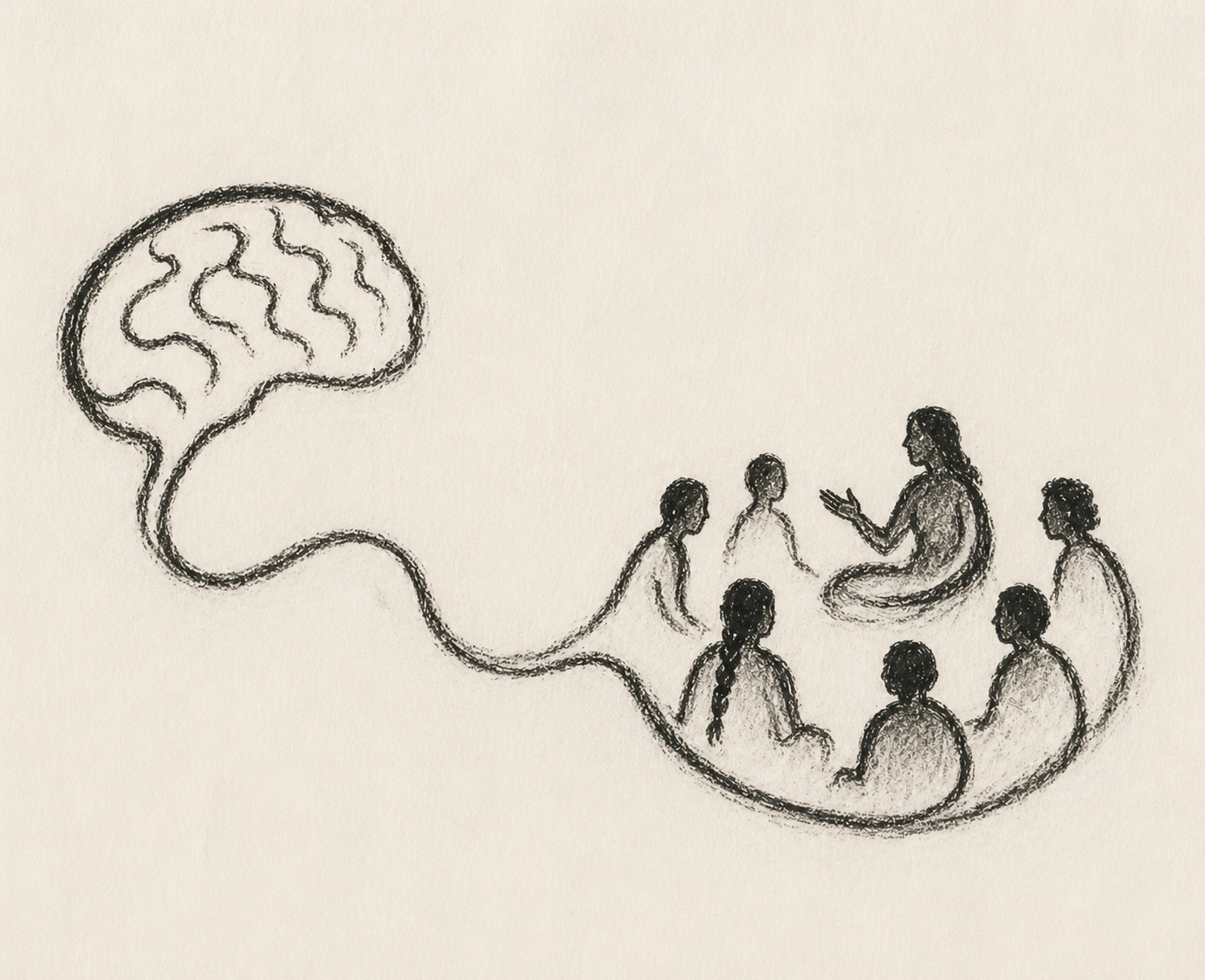
    The Neuroscience of Meditation and Indigenous Storytelling

    Posted on April 27, 2026April 27, 2026

    From inward attention and self-regulation to shared meaning, memory, and relationship

    It is now widely accepted that Western neuroscience has something meaningful to offer the modern practice of meditation. By identifying neural correlates of attention, awareness, and emotional regulation, it has helped clarify mechanisms that practitioners have long described from within. What remains less clear is how this same lens might extend to other cultural practices, such as Indigenous storytelling. If meditation has been understood as a disciplined training of attention, storytelling may reveal a different but equally structured mode of mind, one that binds attention to memory, identity, and relationship. I am not Indigenous, but I offer these reflections with care, with the view that neuroscience can provide meaningful insight into aspects of this practice, even if it cannot fully account for it.

    With meditation, the science has largely focused on the regulation of attention and self. Studies often point to changes in the default mode network, the prefrontal cortex, and the insula. These correlate with reduced rumination, steadier focus, and heightened awareness of the body. The practice is often solitary, deliberate, and method-driven. The brain findings map neatly onto that structure.

    With Indigenous storytelling, the experience is less about directing attention inward and more about being drawn into a shared field of meaning. Neuroscience suggests several overlapping processes at work. When we listen deeply to a story, the brain enters a state of narrative absorption. Sensory and associative regions activate as if we are partially living the events. The usual analytic voice softens. This begins to resemble meditative immersion, though reached through story rather than breath.

    At the same time, storytelling strongly engages memory systems, especially those linked to identity. The hippocampus helps bind narrative to place, lineage, and personal meaning. Repetition deepens this encoding. What is being trained is not just attention, but belonging.

    There is also a social dimension that meditation research is only beginning to touch. In group storytelling, listeners’ brains can synchronize with each other and with the speaker. Rhythm, tone, and pacing entrain attention across the group. Emotion is co-regulated. The experience is not confined to one mind. It is distributed.

    Imagery and metaphor add another layer. Stories guide attention through images rather than instructions. The brain’s perceptual systems engage as if encountering the world directly. In this sense, storytelling becomes a way of training perception itself, shaping how reality is noticed and interpreted.

    So where meditation trains attention to stabilize and observe, storytelling may train attention to participate, remember, and relate. Neuroscience does not reduce one to the other, but it shows that both are structured ways of shaping mind and experience. One clarifies the mechanics of focus and awareness. The other reveals how identity, community, and world are carried and renewed through attentive listening.

    Seen this way, the contribution of neuroscience is not to explain storytelling away, but to quietly confirm that something real and trainable is happening there too.

    Training the Brain for a Lifetime

    Posted on March 14, 2026March 14, 2026

    What meditation research suggests about alpha, gamma, and long-term cognitive health

    Meditation research often searches for dramatic findings. Exotic states. Rare neurological signatures. Yet the most consistent observations are quieter and perhaps more consequential.

    Across many studies, regular meditation is associated with stronger alpha rhythms. The brain settles into a state of relaxed, attentive stability. In long-term practitioners another pattern sometimes appears: distinctive gamma synchrony, the fast oscillations linked with large-scale coordination across brain networks.

    These patterns appear often enough that they begin to look less like curiosities and more like markers of training. The nervous system seems to learn how to quiet internal noise while maintaining clarity, and how to coordinate widely separated regions of the brain with unusual precision.

    If sustained over years, such changes may reflect deeper biological effects. A brain operating with greater coherence may manage energy more efficiently, support mitochondrial function, encourage neuroplasticity and neurogenesis, and assist the brain’s own waste-clearing systems. These mechanisms are increasingly studied in relation to long-term cognitive health.

    The conclusions must remain measured. Meditation is not a cure-all, and research continues to evolve. But one implication is difficult to ignore.

    Just as the body benefits from lifelong physical exercise, the brain may benefit from lifelong training of attention. People who neglect cognitive health often experience decline earlier than they expect. Practices that stabilize and integrate the mind may help preserve clarity longer.

    Seen this way, meditation is not merely a method for occasional calm. It is a discipline that may support the long-term maintenance of the brain itself — a quiet investment in cognitive health over the course of a lifetime.

    The term, meditation, sticks

    Posted on February 25, 2026April 14, 2026

    I’m creating a new taxonomy for my meditation series and writing after years of careful study and analysis. I have no sentimentality, and am dropping long-favored terms like mindfulness and awakening. The basic term, meditation, however, denies change. I know it has too many meanings and uses, and is prey to misuse by charlatans, but it is still the best term for the modern practice I describe, grounded in traditional Buddhism, bolstered with neuroscience and neurotech, and creatively expressed with sound art. I think the term, meditation, sticks. I remain open to your thoughts.

    Meditation as Nervous System Training

    Posted on January 25, 2026January 25, 2026

    How attention, awareness, and repetition gradually reshape the mind

    Announcement

    The next Meditation Community series will be themed as the Neuroscience Edition. It will add a layer of neuroscientific explanation to traditional Buddhist meditation. The series will launch in autumn 2026.

    Meditation is not about emptying the mind or achieving special states. At a basic level, it is a way of gently training the nervous system. Modern neuroscience helps explain why this works.

    Attention is trainable
    Attention is supported by networks in the front of the brain that help us focus, choose, and inhibit impulses. Each time you notice your attention has wandered and bring it back, you are exercising these networks. This is not a mistake. The moment you notice distraction is the moment of training.

    The mind wanders by default
    When we are not deliberately focused, the brain naturally activates what is sometimes called the default mode network. This network supports self-talk, memory, and imagining the future. Meditation does not stop thinking. It changes our relationship to thought, so thoughts are seen more clearly and held more lightly.

    Emotion regulation comes from awareness
    Strong emotions are generated in older parts of the brain. Meditation does not suppress emotion. By staying present with sensation and feeling, without immediately reacting, the nervous system gradually learns that emotions can be experienced safely. Calm often appears as a side effect rather than a goal.

    The body is the gateway
    Breath, posture, and bodily awareness influence the nervous system directly. Slow breathing and grounded posture support stability and recovery. Returning attention to physical sensation is one of the most reliable ways to steady the mind.

    Repetition matters
    From a brain perspective, meditation is training. Short, regular practice produces more lasting change than occasional intense experiences. Consistency matters more than depth.

    In simple terms
    Meditation trains us to notice without immediately reacting, steady attention, regulate emotion through awareness, and inhabit the body more fully. It is the slow education of a living nervous system.

    Peer-Led Meditation

    Posted on January 13, 2026January 13, 2026

    On facilitation, letting go, and sitting together

    When I started a meditation group at my workplace in 2019, I suggested to my two colleagues that it be “peer-led.” What I meant at the time was that I did not especially know much about guiding meditations, and their quick embrace of the idea suggested they did not either.

    It turns out it is not hard to guide a meditation. Sit, relax, breathe, meditate in silence for a while, thanks for coming. Of course, there are many kinds of meditation. As our meditation group caught on, hundreds of people have attended, many of whom shared their own meditation knowledge, from music and visualization to yoga nidra and vipassana. I believe it was the peer-led quality of our organization that made so many people feel welcome, not only to join us but to share what they knew.

    Meditation has not always been associated with this kind of peer-led or decentralized organizational structure. For much of its history, it has been transmitted through formal lineages, hierarchical institutions, and clearly defined teacher–student relationships. Authority was conferred by training, ordination, or proximity to a tradition, and the role of the teacher was to preserve and pass on a specific form with fidelity. Access to meditation often depended on geography, culture, language, and permission. In that context, meditation was not something one casually offered to others, but something one received carefully from someone authorized to give it.

    In the meditation community in which I participated at work for the past seven years, and continue to participate, being peer-led was always treated as an essential quality. I understand now that this was not incidental. It may, in fact, have been the defining quality of the community itself.

    That quality expressed itself in many ways. While a small number of people led most meditations, myself included, this is true of most volunteer organizations, and for familiar reasons. Still, there was always room for movement, and movement did happen. At different times, I and other active leaders were away from work for various reasons, and others stepped in, changing how things ran, along with the style and tone of the group.

    Being peer-led also meant that sometimes nothing happened at all. No one signed up to guide a meditation. People showed up and improvised, or simply drifted away. At times it seemed as though everyone had lost interest and the group might fold. More often, it turned out to be just ebb and flow. With the turn of a season, the group would surge back into life again.

    I intend this peer-led quality to guide more explicitly the design of this public meditation community, something like the prime directive of Star Trek. While there is a program design, I invite anyone who is interested to guide a meditation. Whether it fits a designated topic or not, we will make it work. Future phases of the program will offer opportunities for participants to join design sessions, as we explore research and artistic applications of meditation. Finally, while this community operates on my digital platform, I think of it as an open-source model, available to be branched should someone wish to start their own meditation community. I would assist and support this.

    One last thing. I mentioned in the last sitting that, despite my best efforts, there may be an occasion when my power is out, my phone is down, and I cannot join a scheduled meditation. In that case, I invite anyone who is able to take the lead and guide a meditation. Perhaps only to say: sit, relax, breathe, meditate in silence for a while, thanks for coming. Such is the way of a peer-led meditation group.

    The wisdom of meditation is death

    Posted on December 23, 2025April 14, 2026

    The wisdom of meditation is death.
    Sorry not sorry.

    Death teaches that everything changes and nothing lasts,
    that suffering comes from clinging, chasing, and avoidance.

    Even if I accept the end of body and ego,
    I do not personally own an everlasting soul.

    Knowing this on my deathbed is inevitable.
    Knowing it while I still live is wisdom.

    Three ways of being

    Posted on December 22, 2025April 14, 2026

    Three ways of being:

    1. Rolling anxiety
    2. Chasing cravings or goals, with brief interludes of satisfaction
    3. Practicing meditation, with increasing stretches of stillness and bliss

    Up to you

    We are a multiverse 🌀

    Posted on December 15, 2025April 14, 2026

    I am a universe
    You are a universe
    We are a multiverse 🌀

    Cold Water Immersion is a Masterclass in Meditation

    Posted on December 4, 2025December 4, 2025

    Shinto turns to cold squatting beneath freezing waterfalls in winter, standing in icy springs, or repeatedly dousing the body with frigid water — I prefer a winter river

    Shinzen Young tells of his training in the shamanic tradition of Shinto, Japan’s pre-Buddhist tribal religion. Many tribal cultures seek visions of gods or spirits through prolonged exposure to extremes. In India, some Hindus practise the “five fires.” In North America, certain Indigenous traditions use the sweat lodge and the sun dance. These lean toward heat. Shinto goes in the other direction. It turns to cold squatting beneath freezing waterfalls in winter, standing in icy springs, or repeatedly dousing the body with frigid water.

    For Shinzen, this meant approaching a cistern filled with half-frozen water, breaking the ice crust, filling a huge wooden bucket, and then squatting as he dumped the bone-chilling liquid over his bare skin. The water froze as it hit the floor. His towel froze in his hand. He slid around barefoot on the ice, trying to dry himself with a towel that had turned to a board. It was, for him, a horrific ordeal. He suspected that being a thin-skinned Californian did not help.

    I prefer a winter river. There are always three stages. First, my mind tells me not to do it. It warns me that this is a threat to my life. I quiet the mind. Second, as I descend past my waist, I begin to hyperventilate. My body triggers its survival response, drawing blood toward the core. It lasts only seconds. Third, I adapt. After a minute, the cold becomes neutral, even spacious. I stay in for up to five minutes.

    Beginners enter and exit quickly. They cannot silence the mind or allow the body to adapt. They fear death. Experienced practitioners settle into calm. They release the mind’s grip and the fear that shadows it. Immersed in the river, the sense of body and ego separation dissolves. They feel connected with everything. Samadhi.

    Cold water immersion is a masterclass in meditation. In one minute, it teaches you to quiet the mind’s cry for comfort, a skill that carries into every hard thing in life. Or you could spend a lifetime sitting on a pillow. No doubt there are lessons in both practices.

    • 1
    • 2
    • Next
    Join Meditation Community
    Subscribe to Essays
    Shop for Books
    • The Rightward Shift of Liberals and Conservatives
      Understanding the Evolution of Political Labels and Their Implications for Voting The terms […]
    • 1800 The Battery That Changed Neuroscience
      A Neurotech History Series At the end of the eighteenth century, scientists could observe […]
    • What is it Like to Be a Bat, Man?
      Thomas Nagel asks what it is like to be a bat, challenging us to imagine an experience radically […]
    • The Book of Flying by Keith Miller
      Pico is a librarian in a city by the sea. He falls in love with a winged girl, but she rebuffs him […]
    • Human Slop and AI Art
      AI art begins with something only a human can offer: a sketch, a memory, a photograph, a fleeting […]

    Join Meditation Community | Subscribe to Essays | Shop for Books

    ©2026 John Miedema | WordPress Theme by SuperbThemes